Michelangelo's Pietà at a glance
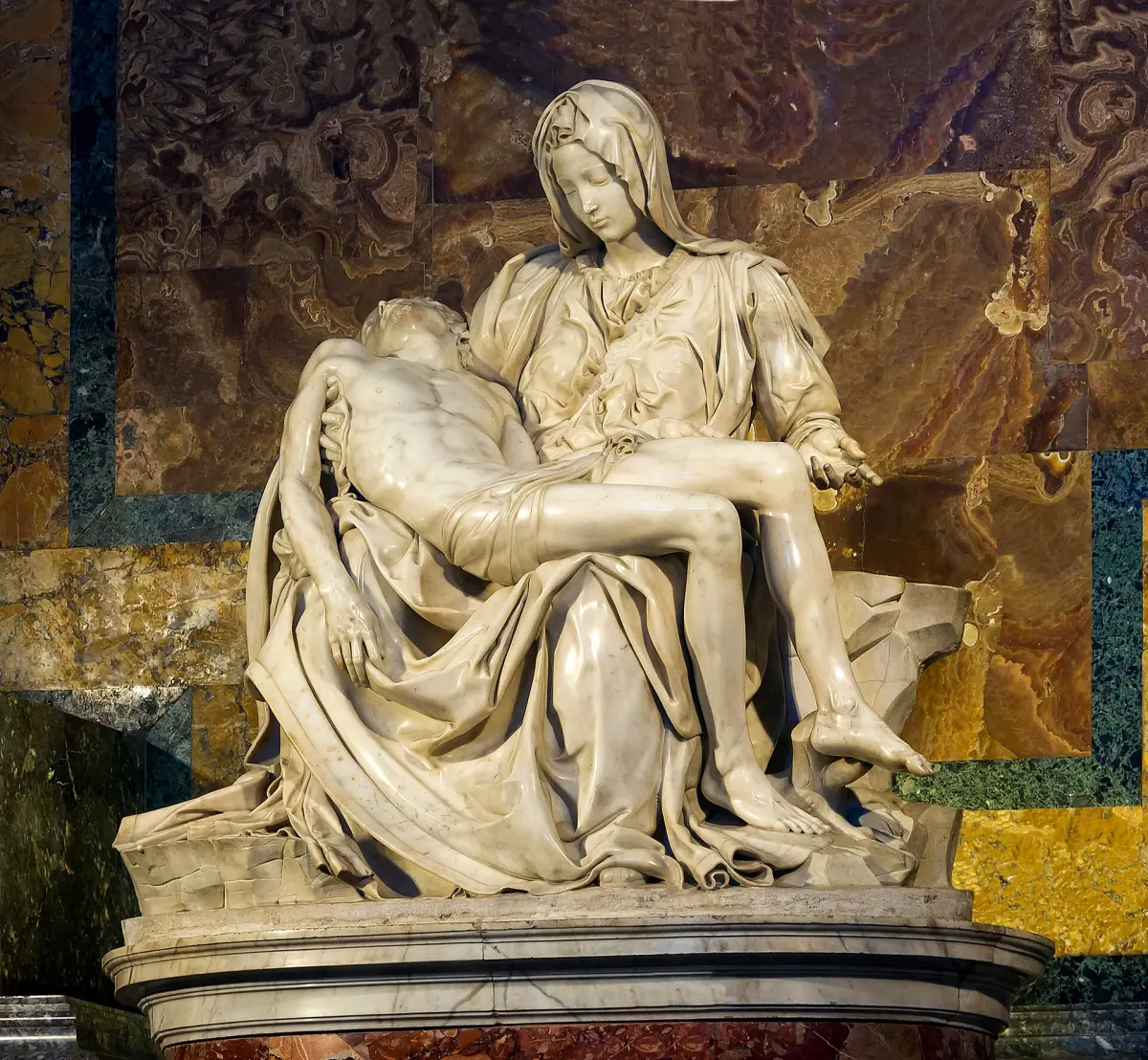
The Pietà shows the Virgin Mary holding the body of Christ after he was taken down from the cross. Michelangelo carved it in 1498 and 1499, when he was about 23 years old, from a single block of Carrara marble. It made him famous almost overnight.
You will find it in the first chapel on the right as you enter St. Peter's Basilica. Seeing it is free: it is part of the basilica, so you only need to pass the security check at the entrance.
The history of the Pietà
The French cardinal Jean de Bilhères Lagraulas, envoy of the King of France to the Pope, commissioned the sculpture for his own tomb. The contract asked for a clothed Virgin with the dead Christ in her arms, "as large as a good-sized man". It was first placed in a chapel of the old Constantinian basilica that no longer exists.
When the old St. Peter's was demolished to make way for the new basilica, the Pietà moved several times. It has stood in its current chapel near the entrance since 1749. It left the Vatican only once, in 1964, when it was shipped to New York for the World's Fair.
What to look for
Details that are easy to miss behind the glass.
The signature
The sash across Mary's chest bears the words "Michael Angelus Bonarotus Florent[inus] facieba[t]", Michelangelo the Florentine made this. It is the only work he ever signed. According to Vasari, he added it after hearing visitors credit the statue to another sculptor.
A young Mary
Mary looks younger than her son. Michelangelo's contemporaries already discussed it, and it is usually read as a sign of her purity.
The composition
A grown man lying across a woman's lap should look awkward. Michelangelo solved it with the deep folds of Mary's robe, which form a wide pyramid that carries the body.
The hands
Mary's right hand holds Christ without touching his skin directly, through a fold of cloth. Her open left hand invites the viewer to contemplate the scene.
St. Peter's Basilica tours with the Pietà
Guided basilica tours and combo tickets that include Michelangelo's Pietà, with live prices and availability.
The 1972 attack and the new glass
On 21 May 1972, a man attacked the Pietà with a hammer, damaging the Virgin's face and left arm. The sculpture was carefully restored, and from 1973 it stood behind a large protective glass pane, which is why you now see it from a few metres away rather than up close.
In 2024, ahead of the Jubilee Year, the Fabbrica di San Pietro replaced the old, clouded pane with nine shatterproof and bulletproof panels of much higher transparency and installed new lighting. The view today is clearer than it has been for decades.
Tips for seeing the Pietà
It is the first masterpiece most visitors reach, so timing matters.
Go first, or last
Turn right immediately after entering, before the crowds build up in front of the chapel. In the early evening it is quieter again.
Opening hours →Photos
Photos without flash are allowed. Stand slightly to the side to avoid reflections in the glass.
With a guide
Guided basilica tours stop here, and a guide brings out details you would not spot alone.
Basilica tickets and tours →Dress code
The basilica dress code applies: shoulders covered, long trousers for men, no hats.
Vatican dress code →Michelangelo's Pietà: frequently asked questions
Where is Michelangelo's Pietà?
In St. Peter's Basilica in Vatican City, in the first chapel on the right after the main entrance.
Do you need a ticket to see the Pietà?
No. The Pietà is inside the basilica, which is free to enter. You only pass the security check.
How old was Michelangelo when he made the Pietà?
About 23. He carved it in 1498 and 1499.
Why is the Pietà behind glass?
Because of a hammer attack in 1972 that damaged the statue. After its restoration it was placed behind protective glass, renewed in 2024.
Is it the only Pietà by Michelangelo?
No, he returned to the theme later in life, but the Pietà in St. Peter's is the only one he fully finished and the only work he signed.